Digital Marketing for Hotels in Oman: How Marketing and Production Agencies Help Hotels Attract More Guests
The hospitality industry in Oman operates in an increasingly digital environment. Before travelers choose a hotel, resort, boutique property, or serviced accommodation, they often search online, compare different options, look at photographs and videos, read reviews, explore social media profiles, and evaluate the available facilities. In many cases, the first interaction between a potential guest and a hotel does not happen at the reception desk. It happens through a search engine, social media platform, travel website, video, advertisement, or hotel website.
This makes digital presence an important part of hotel marketing. A property may offer excellent rooms, restaurants, swimming pools, conference facilities, spa services, or beautiful surroundings, but potential guests need to discover and understand these advantages before they can make a booking.
For hotels in Oman, this is particularly important because the hospitality market serves different types of travelers. These may include international tourists, regional visitors from the Gulf, business travelers, families, couples, adventure travelers, event attendees, and domestic travelers looking for weekend experiences.
A well-planned digital marketing strategy helps a hotel communicate with these audiences at different stages of their decision-making process.
read more about Marassi vs Hacienda Bay
How a marketing agency in Oman can support hotel growth
A professional marketing agency in Oman can help hospitality businesses develop a digital strategy that connects brand awareness with measurable business objectives. Instead of simply publishing promotional posts, the strategy can focus on attracting the right travelers, presenting the hotel experience clearly, encouraging direct inquiries, and supporting bookings.
Hotel digital marketing can include search engine optimization, paid advertising, social media, content marketing, email campaigns, website optimization, reputation management, and performance analysis.
The most effective approach is usually not to treat each activity as an isolated service. Photography, video production, social media, search visibility, advertising, and conversion optimization should support the same overall hotel marketing strategy.
Understanding the Digital Hotel Customer Journey
Travelers usually research before they book
A potential guest may interact with a hotel several times before making a reservation. For example, a traveler planning a trip to Muscat may first search for hotels in the city. After discovering several properties, the traveler may visit their websites, check room photographs, watch videos, read reviews, look at Instagram content, compare prices, and investigate the hotel’s location.
This journey means that hotels need consistent information and branding across multiple digital channels.
A beautiful social media profile cannot compensate for a confusing booking process. Similarly, an attractive website may struggle to generate results if travelers cannot discover it through search or advertising.
Different travelers have different priorities
Digital marketing should also reflect the needs of different guest segments.
A business traveler may prioritize location, Wi-Fi, meeting facilities, airport access, and flexible services. A family may be more interested in room size, swimming pools, restaurants, children’s facilities, and nearby attractions. A couple may respond more strongly to atmosphere, dining experiences, privacy, views, and romantic packages.
A resort in Oman may focus on leisure experiences and destination content, while a city hotel may focus on business travel, convenience, and accessibility.
Understanding these differences allows hotels to create more relevant campaigns and content.
read more about Almaza Bay Egypt
How a Marketing Agency in Oman Helps Hotels Reach Travelers
Building a recognizable hotel brand
Hotel marketing is not only about selling rooms. It is also about building a recognizable identity that travelers can remember.
A hotel brand can communicate a particular experience. For example, a luxury resort may emphasize exclusivity, relaxation, premium dining, and scenery. A boutique hotel may focus on design, personality, local culture, and personalized service. A business hotel may communicate convenience, professionalism, connectivity, and efficiency.
A marketing agency can help translate these characteristics into digital messaging, visual identity, advertising campaigns, website content, and social media communication.
Improving search visibility
Search engines play an important role in the hotel discovery process. Travelers may search for phrases related to hotels in Muscat, resorts in Oman, beachfront accommodation, business hotels, luxury stays, family hotels, or hotels near specific attractions.
Search engine optimization can help a hotel appear more prominently when potential guests are actively researching these topics.
An effective hotel SEO strategy can include:
- Optimizing important website pages
- Creating useful destination content
- Improving hotel service pages
- Targeting relevant search queries
- Optimizing page titles and descriptions
- Improving website speed and mobile usability
- Strengthening internal website structure
- Creating content that answers traveler questions
- Improving local search visibility
- Monitoring organic search performance
The objective is not simply to generate website traffic. The more important goal is to attract travelers whose search intent matches the hotel’s services and location.
Supporting direct bookings
Hotels often depend on third-party booking platforms to reach customers. These platforms can provide significant visibility, but direct bookings can also be valuable because they allow the hotel to develop a more direct relationship with guests.
Digital marketing can support direct booking strategies by driving qualified traffic toward optimized hotel websites and booking pages.
For example, a seasonal campaign could promote a weekend package for travelers in Oman. The advertisement could lead to a dedicated landing page containing the package details, room options, inclusions, photographs, terms, and a clear booking process.
This creates a more focused customer journey than sending every visitor to a generic homepage.
The Role of a Service Production Company in Hotel Marketing
Why visual content is critical in hospitality
Hotels sell experiences that are highly visual. Travelers want to know what a room looks like, how the lobby feels, what the restaurant offers, what the pool looks like, and what they can expect from the destination.
This is where a service production company can become an important part of a hotel’s marketing strategy.
Professional production can transform hotel facilities and experiences into visual assets that can be used across websites, social media, advertisements, promotional campaigns, booking platforms, presentations, and other communication channels.
Professional hotel photography
High-quality photography can influence how travelers perceive a property.
Hotel photography can cover areas such as:
- Guest rooms
- Suites
- Bathrooms
- Hotel entrances
- Lobbies
- Restaurants
- Cafés
- Swimming pools
- Spa facilities
- Meeting rooms
- Outdoor areas
- Views
- Events
- Recreational facilities
- Nearby experiences
The objective should be more than simply documenting the property. Good hospitality photography communicates atmosphere and helps the viewer imagine staying there.
For example, a photograph of a room can show its size, design, natural lighting, bedding, seating area, and view. Restaurant photography can communicate presentation, atmosphere, and dining quality.
Promotional hotel videos
Video can provide a deeper understanding of the hotel experience than individual photographs.
A promotional video might introduce the property from arrival through check-in, room experience, dining, facilities, activities, and surrounding attractions.
Short-form videos can also be created for social media. A resort could produce short videos showing a sunset, pool experience, breakfast, room tour, spa treatment, or weekend package.
Longer videos may be more appropriate for websites, presentations, campaigns, and destination-focused promotions.
Room tours and virtual experiences
Room tours are especially useful because accommodation is one of the primary purchasing decisions for travelers.
A well-produced room tour can show:
- Room layout
- Bed configuration
- Bathroom
- Balcony
- View
- Workspace
- Storage
- Amenities
- Interior design
- Approximate movement through the room
This reduces uncertainty and gives prospective guests a more realistic idea of what they are booking.
Restaurant and food content
Food is an important part of the hospitality experience. Hotels can use professional visual content to showcase restaurants, cafés, breakfast services, special menus, desserts, signature dishes, and dining environments.
For example, a hotel could produce a series of short videos featuring a signature dish, chef preparation, restaurant atmosphere, and customer experience.
This type of content can appeal not only to hotel guests but also to local audiences who may visit the restaurant independently.
Destination and experience videos
Hotels in Oman have another valuable marketing opportunity: destination storytelling.
A property can create content that connects the hotel experience with the surrounding destination. Depending on location, content could highlight beaches, mountains, cultural attractions, traditional markets, landscapes, outdoor activities, historical sites, or local experiences.
The hotel then becomes part of a larger travel story rather than appearing as simply a place to sleep.
read more about Sidi Abdel Rahman Egypt
The Role of a Social Media Marketing Agency Oman
Managing hotel social media professionally
Hotel social media accounts require consistency. A social media marketing agency Oman can help manage content planning, publishing, community interaction, campaign development, and performance analysis.
Instead of posting randomly, the hotel can operate according to a structured content calendar.
Content categories might include:
- Rooms and suites
- Hotel facilities
- Restaurants
- Guest experiences
- Seasonal offers
- Local attractions
- Behind-the-scenes content
- Staff stories
- Events
- Customer-generated content
- Travel tips
- Destination information
- Frequently asked questions
This variety prevents the account from becoming a continuous stream of sales messages.
Creating content that encourages engagement
Social media users generally respond better to content that provides a reason to stop scrolling.
For a hotel, this could mean visually attractive room content, short destination videos, restaurant reels, behind-the-scenes stories, polls, questions, travel tips, or seasonal experiences.
For example, a resort could ask followers which experience they would choose for a weekend: a beach breakfast, spa treatment, pool day, or sunset dinner.
Interactive content can generate engagement while also revealing useful information about audience interests.
Promoting seasonal offers
Hospitality demand can change throughout the year. Hotels may create campaigns around holidays, school breaks, weekends, special events, summer periods, winter travel, dining promotions, weddings, conferences, and other occasions.
Social media provides an effective channel for communicating these offers.
However, a successful promotional campaign should clearly explain the value of the offer. Instead of simply saying “Book now,” the content can communicate what the guest receives, who the offer is suitable for, when it is available, and how to reserve.
Paid social media campaigns
Organic reach alone may not be enough to reach the desired audience. Paid campaigns can allow hotels to target specific audiences according to factors such as location, interests, travel behavior, demographics, and campaign objectives.
For example, a hotel could develop different campaigns for:
- Travelers considering Oman
- Residents planning a weekend stay
- Business travelers
- Families
- Couples
- Event organizers
- Corporate customers
- Guests interested in dining experiences
Different audiences can receive different creative messages instead of seeing the same generic advertisement.
How the Three Services Work Together
Marketing strategy provides the direction
The marketing agency establishes the broader digital strategy.
It can identify target audiences, positioning, marketing objectives, search opportunities, advertising channels, conversion goals, and performance metrics.
Without this strategic layer, content production and social media activity can become disconnected from business objectives.
Production creates the visual assets
The service production company turns the strategy into professional visual content.
The production team can create photography, videos, room tours, restaurant content, destination material, and other assets.
These assets can then be used across multiple marketing channels.
Social media distributes and activates the content
The social media marketing team can adapt the production assets for different platforms and campaigns.
A single hotel photography session could generate website images, social media posts, advertisements, stories, promotional graphics, and campaign materials.
Likewise, one professionally produced hotel video could be edited into several shorter pieces for different digital channels.
This integrated approach makes the marketing investment more efficient.
Practical Hotel Marketing Examples in Oman
Example: A city hotel in Muscat
Imagine a business-oriented hotel in Muscat that wants to increase weekday occupancy.
The marketing strategy could focus on business travelers and companies.
The production team could create professional images of meeting rooms, workspaces, rooms, breakfast, business facilities, and common areas.
The social media team could create content around business travel, while paid campaigns target professionals and companies.
The website could include dedicated pages for business accommodation and meetings.
The result is a coordinated strategy in which every component supports the same commercial objective.
Example: A luxury resort
A luxury resort may focus on couples, families, international tourists, and high-value leisure travelers.
Its visual strategy could include cinematic videos, room tours, restaurant photography, spa content, beach experiences, sunset scenes, and destination footage.
Social media could then use these assets to build an aspirational image of the property.
Paid campaigns could promote specific packages, while SEO content could target searches related to luxury resorts and destination experiences.
Example: A boutique hotel
Boutique hotels often compete through individuality rather than size.
The strategy could emphasize architecture, interior design, local culture, personalized service, neighborhood experiences, and unique guest moments.
Instead of presenting the hotel as a collection of rooms, marketing content could tell a story about what makes staying there different.
This is where storytelling, photography, video, and social media can work particularly well together.
Example: A hospitality business with a restaurant
A hospitality business may generate revenue from both accommodation and food and beverage services.
The digital strategy could therefore separate campaigns according to customer intent.
One campaign might promote rooms and weekend stays, while another promotes the restaurant to local residents.
Professional food photography and video can support restaurant campaigns, while room photography supports accommodation campaigns.
read more about seafood restaurants El Alamein
Choosing the Right Marketing Partner for a Hotel
Understand the agency’s hospitality experience
Hotel marketing has unique characteristics. A general marketing agency may understand digital advertising but have limited experience with hospitality customer journeys.
When evaluating potential partners, hotel managers should ask whether the agency understands accommodation marketing, travel audiences, seasonal demand, direct bookings, restaurants, events, and destination positioning.
Relevant experience can help an agency anticipate challenges more effectively.
Look beyond follower counts
A large social media following does not necessarily mean a hotel is generating strong commercial results.
Hotels should examine metrics such as website traffic quality, inquiries, direct bookings, conversion rates, advertising performance, engagement quality, and return on marketing investment.
The right partner should connect marketing activity to business outcomes.
Evaluate the production quality
For hospitality businesses, visual quality matters considerably.
Hotels should examine previous photography and video projects and assess whether the agency can capture rooms, facilities, food, people, atmosphere, and experiences in a professional and authentic way.
The goal should be attractive content that still represents the actual guest experience accurately.
Ask how performance is measured
A marketing partner should establish clear KPIs before campaigns begin.
Reports should explain what happened, why it happened, and what should be improved next.
This is more useful than reporting only the number of posts published or impressions generated.
Important Hotel Digital Marketing KPIs
Website and booking metrics
Hotels can monitor:
- Website sessions
- Organic traffic
- Traffic from paid campaigns
- Booking conversion rate
- Direct booking volume
- Booking page abandonment
- Cost per booking
- Revenue generated through digital campaigns
These metrics help determine whether digital traffic is translating into commercial activity.
Social media metrics
Important social metrics may include:
- Engagement rate
- Video views
- Watch time
- Reach
- Saves
- Shares
- Profile visits
- Website clicks
- Direct inquiries
- Campaign conversions
The most useful metrics depend on the objective. A brand-awareness campaign may prioritize reach and video consumption, while a booking campaign should focus more heavily on clicks, conversions, and revenue.
Advertising metrics
Paid campaigns can be evaluated using metrics such as:
- Click-through rate
- Cost per click
- Cost per acquisition
- Conversion rate
- Return on advertising spend
- Landing page performance
Hotels should avoid judging a campaign using one metric alone. A campaign with a low cost per click may still be unsuccessful if the traffic does not generate bookings.
Common Digital Marketing Mistakes Hotels Should Avoid
Relying on outdated photographs
Travelers want to see what they are actually booking.
If hotel rooms have been renovated or facilities have changed, outdated images can create unrealistic expectations.
Regularly updating visual content helps maintain accuracy and trust.
Posting only promotional content
An account that constantly says “Book now” can become repetitive.
Hotels should balance promotional posts with informative, inspirational, entertaining, and experience-based content.
Travel tips, destination information, food content, staff stories, room tours, and behind-the-scenes material can all contribute to a stronger content strategy.
Ignoring mobile users
Many travelers research hotels using smartphones.
If the website is difficult to navigate on mobile devices, loads slowly, or makes the booking process complicated, potential guests may leave before completing a reservation.
Mobile optimization should therefore be part of the digital strategy rather than an afterthought.
Not responding to online audiences
Social media is not simply a publishing platform.
Travelers may ask questions about room availability, facilities, parking, restaurants, check-in times, locations, or special offers.
Slow or inconsistent responses can negatively affect the customer experience.
Focusing on traffic without measuring bookings
Thousands of website visitors do not automatically mean a successful hotel campaign.
Marketing teams should determine whether visitors are qualified and whether they move toward meaningful actions such as inquiries or bookings.
Using the same message for every audience
A family traveler and a corporate traveler may have completely different priorities.
Audience segmentation allows hotels to communicate benefits that are more relevant to each group.
read more about cafes North Coast Egypt
Creating a Connected Digital Strategy for Hotels in Oman
Digital marketing gives hotels in Oman an opportunity to reach travelers before they arrive at the property. However, successful hotel marketing requires more than maintaining a website or publishing occasional social media posts.
A strong strategy connects multiple functions.
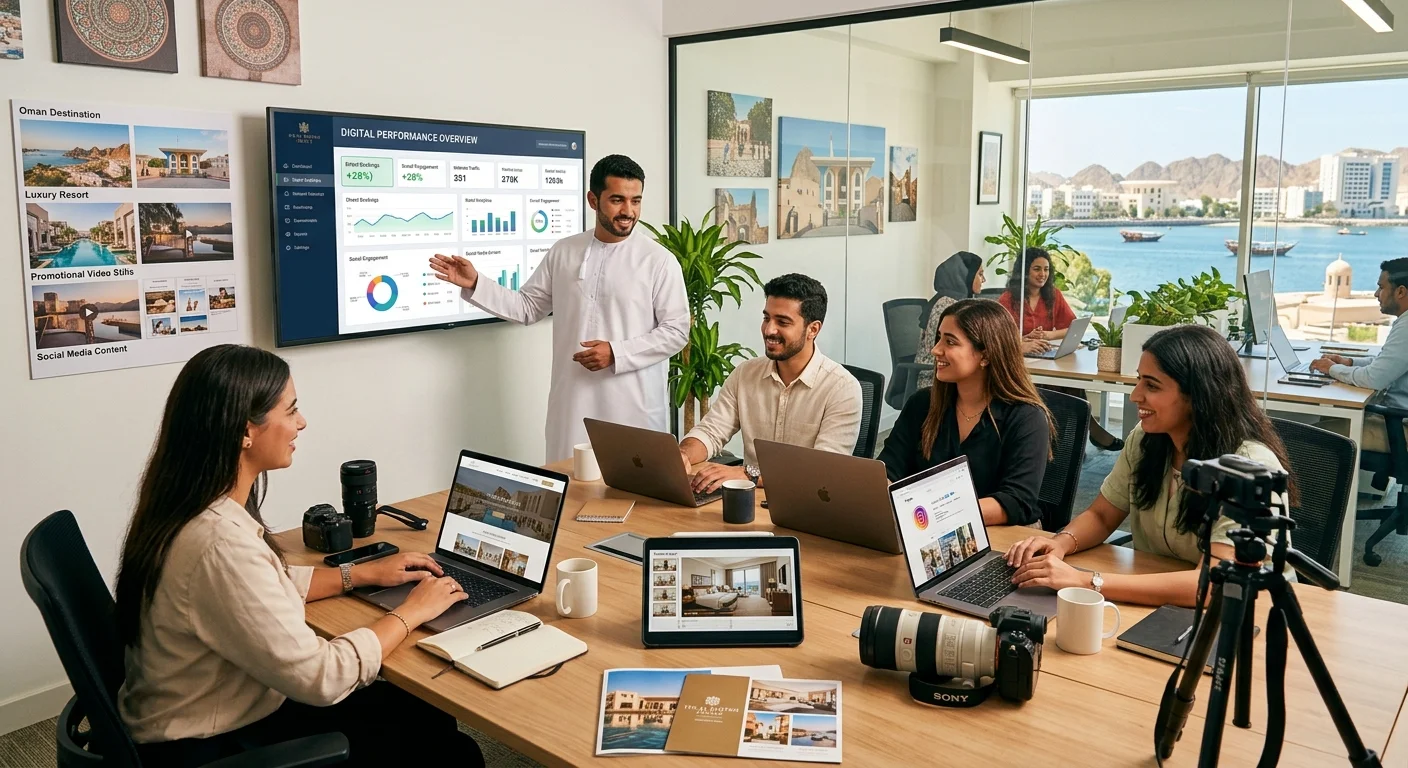
A marketing agency in Oman can provide the strategic direction needed to identify audiences, improve online visibility, develop campaigns, and measure performance. A service production company can transform the hotel’s rooms, facilities, restaurants, experiences, and destination into professional visual content. Meanwhile, a social media marketing agency Oman can distribute that content, engage audiences, promote offers, and use paid campaigns to reach potential travelers.
When these services operate together, the hotel can create a consistent customer journey from discovery to consideration and, ultimately, booking.
For hotels, resorts, boutique properties, restaurants, and other hospitality businesses in Oman, the central question should not simply be how to get more digital visibility. The more useful question is how every digital interaction can help a potential guest understand the experience, trust the brand, and take the next step toward choosing the property.
A coordinated approach to strategy, production, social media, SEO, advertising, and conversion can make digital marketing more useful, measurable, and aligned with the actual goals of the hospitality business. In a competitive travel market, that consistency can become an important advantage.